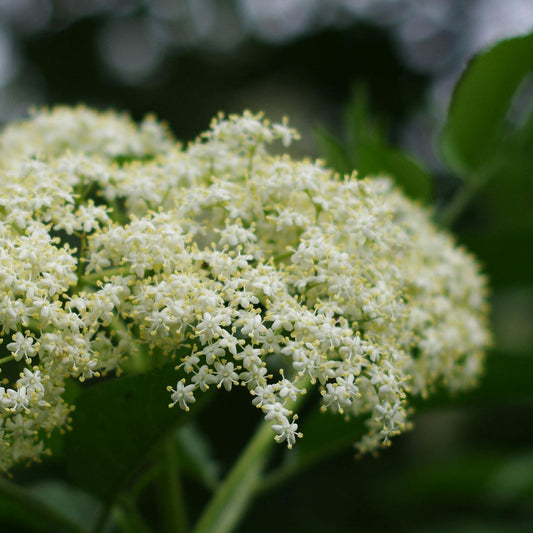
Elderberry: The immune-boosting herb having a well-deserved moment
Elderberry (Sambucus nigra) has been used as medicine for centuries, and right now it's having a well-deserved resurgence thanks to growing scientific interest in its properties. We grow it here on the Mid North Coast, and honestly — it's one of those plants that never stops giving.
A note on varieties
There are several elderberry varieties, but three are worth knowing about in Australia:
American Elder (Sambucus nigra canadensis) — the most common variety grown here. It's vigorous, likes wet areas, and grows prolifically. It's not deciduous, which means we get flowers and berries year-round. It does sucker, so it needs watching, but the medicinal rewards are well worth it.
European Elder — doesn't sucker as much and is deciduous, but is harder to grow in Australian conditions.
Native Elder — a native variety with yellow flowers. Less is known about its medicinal properties.
We grow the American Elder, and while its enthusiasm for spreading keeps us on our toes — and the birds are very fond of the berries — we feel incredibly fortunate to have it.
It propagates easily from cuttings. Planting from seed is also possible, but we haven't tried it ourselves.
The flowers
Elder flowers are beautiful — delicate, white, and lace-like. Fresh or dried, they have a long history of use for:
- Colds, coughs, flu, sinus congestion and sore throats
- Fever management
- Immune support
- Antiviral properties
- Blood purification
- Externally: soothing inflammation and cleansing skin
They're wonderfully versatile — we add them to teas, oxymels, syrups, and face cleansers, among other things.
The berries
Elderberries have a rich, delicious flavour and are just as medicinally valuable as the flowers. One important note: always cook the berries before consuming — the seeds can cause gastric reactions in some people when eaten raw.
Fresh, dried, or frozen, elderberries are used for:
- Immune strengthening (this is what elderberry is best known for)
- Respiratory complaints
- Antiviral and antibacterial support
- As an expectorant
- Antioxidant-rich tonic
- Gentle laxative
We've made syrups, jams, and oxymels with the berries regularly — but there's so much more you can do with them.
Nutrition
Both the flowers and berries are remarkably nutrient-dense. They contain vitamins A, B1, B2, B3, B4, B5, B6, C and H, along with minerals including calcium, magnesium, iron, phosphorus and copper, plus all essential amino acids.
It really is one of the most complete medicinal plants we know of — and one we use daily, in some form or another.
This post is for educational purposes only and is not intended as medical advice. Please consult a qualified healthcare professional before using herbal preparations to treat any health condition.